 Download this Summary Report as a PDF (16 pages, 450KB)
(Please note that this PDF is designed for printing purposes and has not been remediated for accessibility)
The Big Youth Survey is designed to gather the views of children and young people aged 12–21 living in Northern Ireland on the issues that matter most to them. The survey, which takes place at the start of each Youth Assembly mandate, informs the work of the newly appointed Northern Ireland Youth Assembly Members at the beginning of their two-year mandate.
Young people were asked to choose the issues that matter most to them from a list compiled by Youth Assembly Members. The issues were presented in alphabetical order, and respondents were asked to pick their top three. The survey was promoted via social media and through Youth Assembly Members’ networks. It was also sent to every post-primary school in Northern Ireland.
The survey opened on 1 December and closed on 19 December 2025. In total, 1,673 young people took part. The results were used to identify the issues most important to young people. These issues will be debated by the Northern Ireland Youth Assembly, and Members will decide on three main issues which will form the basis of their committees for this term.
The first question asked young people to tell us their age. This helps us understand who took part in the Big Youth Survey.
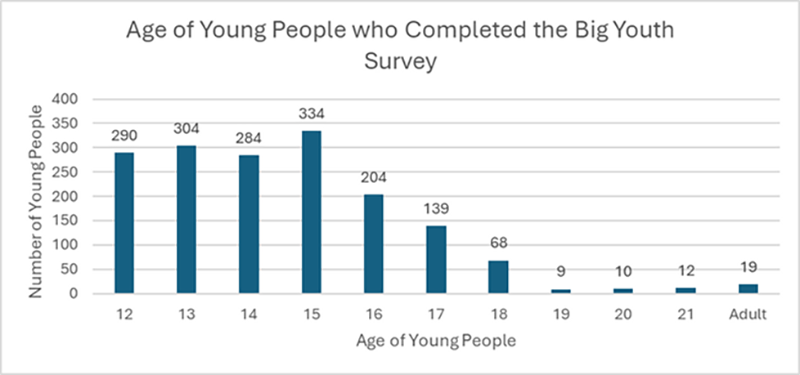
The graph above shows that most of the responses came from young people aged 12 to 16, with the largest number of responses from 15 year olds. In addition, 19 responses were submitted by adults responding on behalf of a young person, making sure that everyone’s voices could be heard.
Ahead of the survey launch, Youth Assembly Members worked together to agree on a shortlist of issues to include. This list was developed through group discussions, based on the issues Members care most about and those they believe have the biggest impact on children and young people living in Northern Ireland.
Below is the final list of 22 key issues which were presented in the survey.
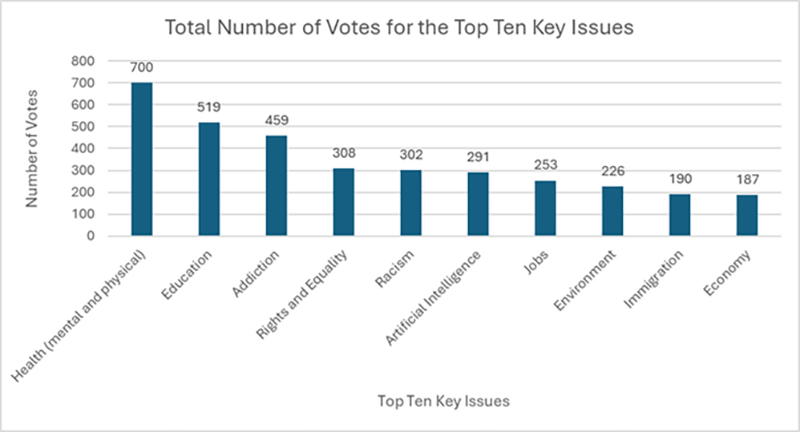
When all the votes were added together, the results showed that a small number of issues stood out as being most important to many young people. The graph below shows which ten issues received the highest number of votes.
The next graph looks more closely at which issues were chosen as the most important. It shows how young people voted when asked to pick their top priority (number one). The graph below shows which ten issues received the highest number of ‘number one’ votes.
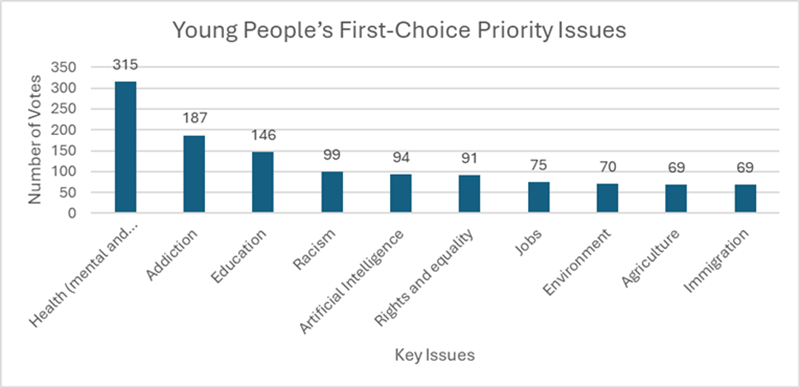
The results show that there is a lot of overlap between the issues young people chose most often and the issues chosen as the number one priority. In most cases, the same issues appear in both lists.
There is only one small difference. Economy appears in the overall top 10 because it was often included in young people’s top three choices, but it does not appear in the top 10 when looking only at first-choice votes. On the other hand, Agriculture appears in the top 10 first-choice issues but does not feature in the overall top 10.
To reflect this clearly and fairly, the report includes the top 11 issues.
These eleven issues will now go forward to be debated and voted on by Youth Assembly Members, who will decide the final priorities for their mandate.
The survey also included an open-text question inviting young people to explain their priorities in their own words. After ranking their top three issues, young people were asked: “Can you tell us why this issue is important to you?” This question was designed to capture the lived experiences, concerns, and motivations behind their selections.
The written comments help explain the numbers. They show not just which issues young people chose, but why those issues matter, and how they affect their everyday lives, wellbeing, and future opportunities.
Young people who chose Health as their most important issue spoke strongly about the scale and urgency of mental health needs among young people. Many described a “mental health epidemic” or “crisis on the rise,” with repeated concerns that teenage mental health is dismissed, minimised, or not taken seriously. A number of young people shared personal experiences of struggling with anxiety, depression, or suicidal thoughts, while others referenced the devastating impact of losing friends or family members. Young people repeatedly linked poor mental health to bullying, stress, academic pressure, and social media, noting that young people can feel unable to speak up due to fear of judgement, stigma, or consequences.
Alongside these concerns, young people raised consistent and specific criticism of the health system’s capacity and responsiveness, particularly regarding access, waiting times, and quality of care. Many described the system as “broken” or “in shambles,” with long waits for appointments, assessments, diagnoses, and treatment, and a sense that young people can reach “crisis point” before being seen. Others highlighted that pressures and underfunding place strain on staff and knock-on pressure on other services such as ambulance, police, and emergency departments. While mental health dominated the qualitative responses, young people also pointed to physical health issues, such as chronic illness, injuries, hidden illnesses, and the educational impact of waiting years for assessment or treatment. Young people raised concerns about geographical inequality, for example the implications of reduced local access to hospital services and the need to travel long distances for urgent care.
Young people who chose Health as their most important issue spoke strongly about the scale and urgency of mental health needs among young people. Many described a “mental health epidemic” or “crisis on the rise,” with repeated concerns that teenage mental health is dismissed, minimised, or not taken seriously. A number of young people shared personal experiences of struggling with anxiety, depression, or suicidal thoughts, while others referenced the devastating impact of losing friends or family members. Young people repeatedly linked poor mental health to bullying, stress, academic pressure, and social media, noting that young people can feel unable to speak up due to fear of judgement, stigma, or consequences.
Alongside these concerns, young people raised consistent and specific criticism of the health system’s capacity and responsiveness, particularly regarding access, waiting times, and quality of care. Many described the system as “broken” or “in shambles,” with long waits for appointments, assessments, diagnoses, and treatment, and a sense that young people can reach “crisis point” before being seen. Others highlighted that pressures and underfunding place strain on staff and knock-on pressure on other services such as ambulance, police, and emergency departments. While mental health dominated the qualitative responses, young people also pointed to physical health issues, such as chronic illness, injuries, hidden illnesses, and the educational impact of waiting years for assessment or treatment. Young people raised concerns about geographical inequality, for example the implications of reduced local access to hospital services and the need to travel long distances for urgent care.
Young people who chose Addiction as their most important issue said it is “very common” and becoming more normalised among young people, especially when it comes to vaping, alcohol, and drugs. Many emphasised early exposure and ease of access, noting that “far too many young people are addicted to vapes” and that substances are “easily accessed by young people,” with some observing that drinking can begin at “13 or 14” and is treated as “the norm,” especially in rural areas where the issue is “largely unspoken about.” Several young people linked addiction to social pressures and vulnerability, describing young people getting “mixed in the wrong crowds,” being influenced by friends, and not knowing how to say no, while others highlighted the role of boredom and lack of opportunity.
Young people also articulated concerns about the harms and wider ripple effects of addiction. They referenced risks to physical and mental health, particularly the impact on “developing brains and bodies,” and described addiction as “dangerous,” “life changing,” and something that “can lead to death,” with some explicitly connecting it to “suicide,” poverty, and community-level impacts. Many framed addiction as a family issue, describing “countless families” affected. Alongside this, young people identified a perceived gap in support, education, and treatment pathways, stating that the issue “needs to be spoken about a lot more,” and that there is “a lack of support” available.
Young people who chose Racism as their most important issue said it is an ongoing problem in Northern Ireland and, in some places, is getting worse. They spoke about how racism affects safety, belonging, and wellbeing, and how it can make people feel excluded or unsafe. Many referred to racism as “everywhere,” with several pointing to a perceived increase in racist behaviour and hostility within their own communities. Young people referenced recent incidents of public disorder and protests, describing “disgusting behaviour” towards those “who weren’t born from fully Irish parents,” and expressed frustration that racism is “never dealt with properly and fairly.” Others highlighted that racism is becoming “normalised,” especially among younger teenagers, including the use of racial slurs in school and casual stereotyping that is left unchallenged. A repeated theme was that racism is not an abstract issue, but a lived reality shaping everyday experiences in society.
A second dominant theme was the harm and impact of racism, particularly for young people from minority ethnic backgrounds. Young people shared direct experiences of racist abuse, including racial slurs and hate incidents, and described feeling “targeted,” “left out,” or unsafe, with some reporting fear about going out because of assaults they hear about. Several young people spoke about friends being forced to change schools or change gyms for safety reasons, and others described abuse coming from adults as well as peers, including the experience of being a young teenager subjected to racial slurs by people “above 30.” Many argued that racism persists because of “lack of education and understanding,” misinformation, and societal unwillingness to confront discrimination directly, and they emphasised that no one should be treated differently for characteristics they cannot control.
Young people who chose Rights and Equality as their most important issue said it is the foundation of a fair society and key to young people’s future opportunities. Many emphasised that society functions best “when everyone is heard” and when people have “the same tools to start their life,” linking equality to opportunity, dignity, and the ability to participate without being treated as “below” others. A prominent strand focused on gender equality, with references to unequal treatment of women and girls, the gender pay gap, and the reality that many “still feel unsafe.” Several young people connected this to wider patterns of harm, including an “increase in violence against women.”
Young people also highlighted rights and equality as urgent because of the continued marginalisation of specific groups. Young people described a perceived lack of representation and protection for LGBTQIA+ youth “in both education and legislation,” alongside fears of political or societal “pushback” against minority rights and a wider decline in empathy. Others spoke of racism, sexism, homophobia, and religious discrimination as lived realities, noting that people can be treated differently for characteristics they “can’t control.” A number of young people located these concerns within both local and global contexts, referencing rights issues in other countries, the rights of Palestinian people, and the need to ensure rights are upheld “everywhere in N.I.” amid demographic change.
Young people who chose Artificial Intelligence (AI) as their most important issue said it is growing very quickly and is already affecting their lives, often in ways that feel uncertain and hard to control. A key concern was trust and authenticity, with young people saying it is “scary how it’s everywhere” and increasingly hard to tell “what is fake or not,” with repeated references to misinformation, manipulated images, and the potential for deepfakes. Young people expressed anxiety that AI can be “used for the wrong thing,” enabling harm at scale, including new forms of bullying through “embarrassing images” generated from a single photo.
A second strong theme was the perceived impact of AI on education, skills, and future opportunities. Many young people described widespread use of AI tools for homework and assignments, raising concerns that pupils “do not actually learn anything” and may become overly dependent, undermining critical thinking, writing, and study skills. Others worried about fairness and credibility in assessment, noting that AI complicates how teachers can ensure internal assessments are equitable, and that pupils can gain “great marks” through AI use. Beyond school, young people repeatedly voiced anxiety about AI “taking jobs,” especially in creative industries such as writing and art, and about the possibility that careers may be displaced before young people even enter the workforce. Some described the personal impact starkly, expressing fear for their future and questioning what kind of world they are “growing up in.” Finally, young people also raised the environmental cost of AI, describing it as “bad for the planet” and linking it to climate concerns.
Young people who chose Jobs as their most important issue said that having a job is key to financial security and independence, especially with the rising cost of living. Many framed jobs in straightforward terms as necessary “to live,” “to buy food,” “to get a house,” and “to provide for your family,” with several explicitly noting the pressure on “struggling families” and the need for young people to earn a wage to support themselves or contribute at home. Alongside this, young people expressed anxiety about their own futures, including uncertainty about what career to pursue and feeling nervous about entering the workforce.
A repeated theme was the perceived barriers young people face in accessing work, especially the “experience trap”: young people described finding a job as “near impossible” because employers require experience, yet young people cannot gain experience without first being employed. Where jobs are available, some young people felt they are often insecure or unsuitable, citing reliance on “zero hour contracts” or “seasonal temp jobs” that do not provide stable income. Others highlighted the practical strain of balancing part-time work with school, sport, and other responsibilities.
Young people who chose the Environment as their most important issue said that climate change and environmental damage are urgent threats, affecting both the planet and everyday life. Many framed the issue in existential terms, stating that “we only have one earth” and that “none of these other issues matter if our environment is dying.” A recurring theme was fear and urgency around climate change, with young people describing global warming as “terrifying,” at a “dangerous turning point,” and in some comments as effectively irreversible if action is not taken. Young people repeatedly emphasised that they expect to live with the long-term consequences, noting that there is “absolutely nothing major happening” to prevent climate change even though they will be “the generation who will be suffering the consequences.” Several also linked environmental decline to the availability of natural resources, arguing that without better stewardship the planet may no longer be able to provide what people need to live.
A second strong theme centred on stewardship, wildlife, and visible local environmental neglect. Young people frequently referenced pollution, litter, plastics, and microplastics, both as a global concern (“more plastic in the sea than fish”) and as an immediate local problem (“there is always litter,” “lots of pollution,” rubbish in parks and towns). Many explicitly connected environmental harm to risks for animals and biodiversity, including extinction and habitat destruction, with concerns that damaging ecosystems “puts animals at risk” and undermines hope for “future generations.” Several comments expressed frustration with perceived political inaction, describing the environmental state in Northern Ireland as “an absolute joke” and calling for stronger leadership and education so that young people and communities can better understand their impact and take meaningful action. Overall, young people presented the environment as a cross-cutting priority: protecting nature was framed as basic responsibility and “human decency,” essential not only for global sustainability but also for ensuring Northern Ireland remains a healthy, safe, and enjoyable place to live.
Young people who chose Immigration as their most important issue talked about pressure on
public services and the need for clearer rules and decision-making. Many linked immigration to concerns about healthcare, housing, and the economy. Alongside these points, young people frequently emphasised that immigration “needs managed,” with repeated calls for better control, clearer rules, and reassurance that people entering the country are “allowed,” documented, and accounted for.
At the same time, responses revealed that immigration is experienced as a highly contentious and emotionally charged topic, shaped by local tensions and recent incidents. Some young people referenced protests, disorder, and heightened community conflict, describing immigration as a driver of division and insecurity in their area. Others challenged anti-immigrant narratives and emphasised fairness and safety for migrants, reflecting that Irish history includes emigration and therefore should encourage compassion.
Young people who chose the Economy as their most important issue often linked it to the cost of living and how affordable everyday life feels. Many of their comments were direct and practical, focusing on the real impact of rising prices on daily life: “everything is expensive,” prices are “going up too high,” and inflation is “absolutely terrible.” Young people described feeling stressed and uncertain about how they will afford major milestones such as housing, driving lessons, cars, and living independently, with several suggesting that home ownership may only be possible “through inheritance.” In this sense, economic concern was often expressed as future-facing anxiety.
Young people repeatedly noted that a strong economy underpins jobs, public services, and overall stability, and that economic decline contributes to poverty, homelessness, unemployment, and poor mental health. Several comments explicitly connected economic performance to visible outcomes in communities, including underfunded schools, deteriorating infrastructure (for example roads and potholes), and health services described as “a shambles.” Young people also articulated a clear desire to have a voice on economic policy, arguing that the economy affects “everyone in the country” and that young people should be included in decisions shaping their future.
Young people who selected Agriculture as their most important issue talked about it as being essential to everyday life, using language such as “No farmers, no food, no future.” Many emphasised that agriculture is “the backbone of society” and “the most important job in the world.” Another theme was the perception that farmers are under increasing pressure due to policies and rising costs. Many young people expressed concern about farm inheritance tax policies and the ability to pass farms to the next generation, describing tax as “scary” and unfair.
Young people also expressed frustration that farmers feel blamed or undervalued, suggesting that agriculture is not appreciated by the wider public and that rural issues are poorly understood in schools and towns. Some argued that agriculture is wrongly treated as the cause of environmental harm, stating that farmers see themselves as stewards who “look after the environment,” and that policy approaches framed as environmental protection actually risk “destroying our food sources and family farms.”
Young people were also given the chance to share any issues they felt were missing from the Big Youth Survey. Out of the 1,673 people who took part, 343 young people shared at least one additional issue they felt was not fully captured in the survey.
Around 50 responses focused on education and school life. Even though education was already included in the survey, young people raised specific concerns such as school funding, cold or poor school buildings, the cost and fairness of uniforms and school meals, exam and homework pressure, and a desire for more life skills education, like budgeting, taxes, mortgages, and practical skills.
Another strong theme was safety and harm, especially experiences of bullying, harassment, sexual violence, and violence against women and girls. There were 43 responses linked to these issues, with an additional 37 responses focused specifically on online harm.
Some young people raised issues about participation and politics, including around 12 responses calling for a review of the voting age. Others mentioned religion and freedom of speech and LGBTQ+ issues.
A small number of responses also referred to international conflict and human rights, including war and the situation in Gaza.
Finally, several young people highlighted issues around inclusion and support. These included better understanding of neurodiversity, improved support and funding for SEN and disability, and more opportunities for young people with additional needs. Others pointed to the importance of youth services and community spaces, such as more youth clubs and better public transport.
The Youth Assembly would like to thank everyone who took the time to complete the survey and share their lived experience, perspectives and opinions. Thanks also to those young people and adults in schools, colleges and throughout the youth sector who helped to share the survey with their networks. A further thanks to the individuals, organisations and representatives who helped to amplify the survey by sharing our posts on social media.